Packing a good carry-on isn’t about stuffing your backpack with every travel gadget you own. It is about keeping the things you truly need safe, organized, and easy to reach during the flight.
After years of traveling with my family, I have developed a system that keeps me surprisingly organized on airplanes—even though organization does not always come naturally to me! I use a small Fjällräven Kånken backpack and give everything a specific place. My passport stays in the front pocket, medication and electronics remain safely inside the main compartment, and one small pouch holds everything I need once I am seated.
This carry-on essentials list includes the items I personally use, along with practical advice for deciding what deserves space in your own bag. You may not need every item I carry, but the goal is the same: keep important belongings with you and avoid digging through an overstuffed backpack every twenty minutes.
My Personal Item Packing List
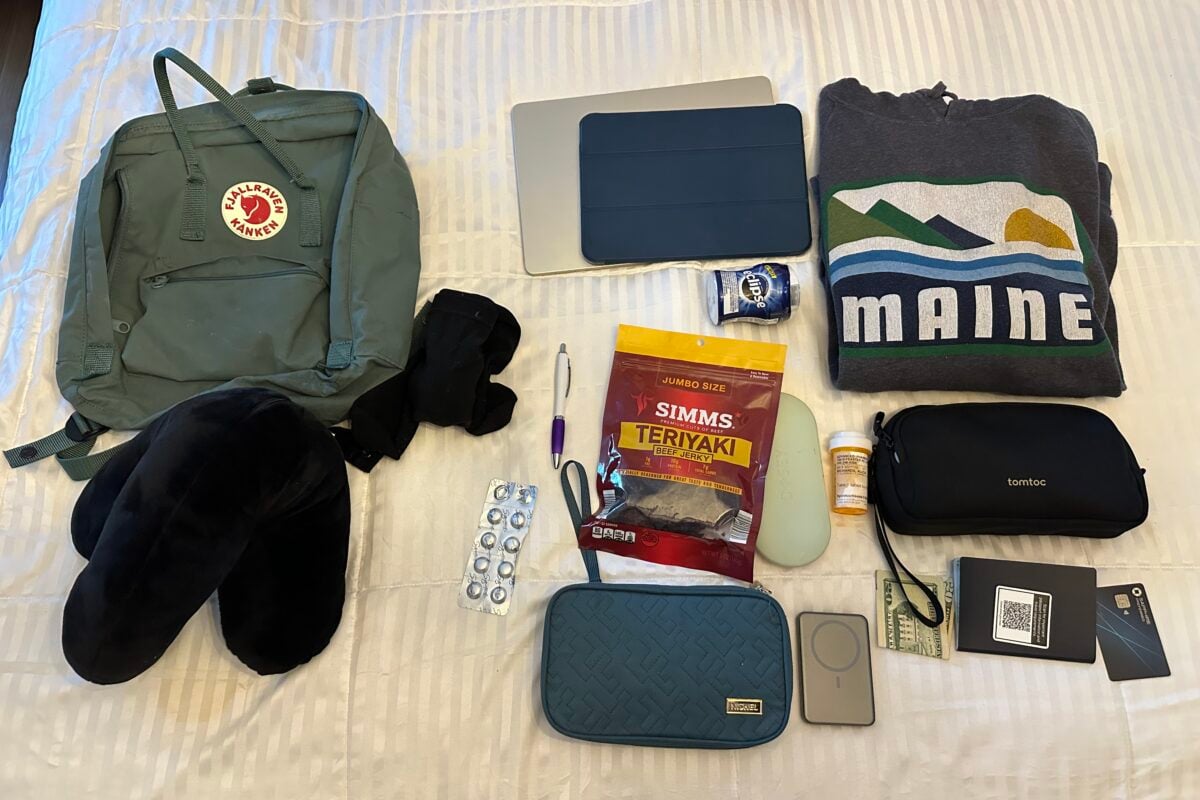
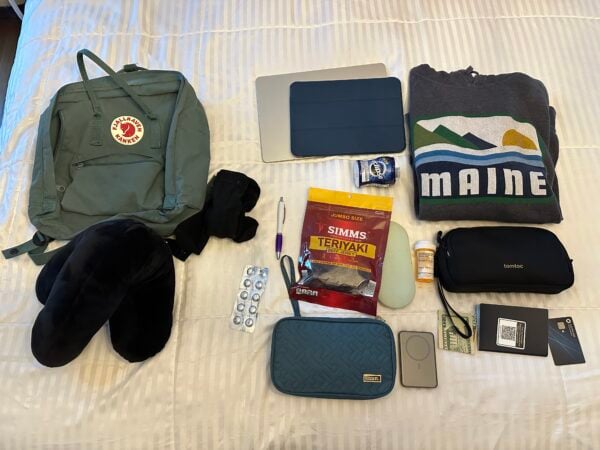
These are the 18 carry-on essentials I keep inside—or attached to—my personal-item backpack.
Important Items
Passport or identification
Prescription medication
Food and Hydration
Beef jerky or another filling snack
Kid-sized Owala water bottle
My In-Flight Pouch
Small zippered pouch
Phone charger with USB-A connection
Bluetooth airplane adapter
AirPods
Lip balm
Tissues
Gum
Comfort Items
Sweater
Compression socks
J-Pillow travel pillow
Entertainment and Work
iPad with downloaded entertainment
Laptop
Practical Backups
Portable charging bank
Pen
Carry-On vs. Personal Item: What Is the Difference?
A carry-on suitcase generally goes into the overhead bin, while a smaller personal item fits underneath the seat in front of you. Airlines may treat them as two separate pieces of luggage, but both are belongings you carry onto the airplane.
The essentials I want during the flight stay in my personal-item backpack rather than my overhead suitcase. This keeps my medication, passport, electronics, food, and comfort items within reach—and prevents me from opening the overhead bin every time I need something.
If you want help packing clothing and toiletries into an overhead suitcase, read my guide to packing a carry-on for 10 days.
How I Pack My Personal Item Perfectly After Years of Flying
I am not naturally the most organized person, but my airplane personal item is an exception. After taking countless flights, I have figured out exactly where everything belongs and which items I actually need during the flight.
I use a Fjällräven Kånken backpack because it is small enough to carry comfortably but large enough to hold my medication, electronics, food, water bottle, sweater, and compression socks. I don’t fill it with “just in case” items that I am unlikely to use. Everything inside has a purpose and a designated place.
The small front pocket holds my passport so I can reach it quickly without opening the entire backpack. My medication, laptop, and iPad stay protected inside the main compartment. The items I might need before or after the flight—such as my sweater, compression socks, beef jerky, and water bottle—are packed where I can reach them without completely unpacking the bag.
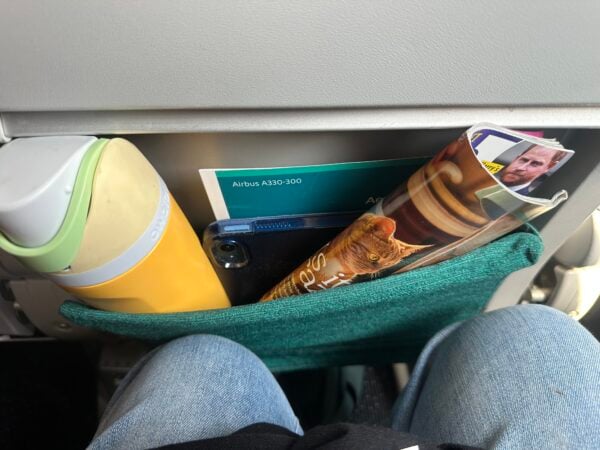
My best trick is using one small in-flight pouch. It contains everything I am likely to need once I sit down, including my AirPods, Bluetooth airplane adapter, phone charger, lip balm, tissues, and gum. I remove that one pouch before placing my backpack under the seat and put it into the seat-back pocket. That way, I am not constantly bending down and digging through my bag during the flight.
The key is to pack according to when you will need each item. Keep documents accessible, protect medication and electronics inside the bag, and place everything you will use during the flight into one removable pouch. It is a simple system, but it makes flying considerably easier.
Want to see exactly what I pack?
You can find my personal-item backpack, in-flight pouch, electronics, comfort items, and other flight essentials in my Amazon storefront.
The first things in your carry-on should be the items that would be difficult—or impossible—to replace after you leave home. Entertainment and comfort items are helpful, but your identification and medication are the real essentials.
1. Passport or Identification
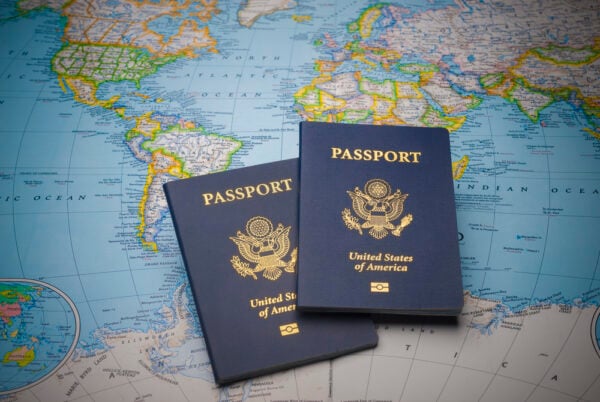
Your passport or identification needs to be secure but easy to reach. You will need it several times between arriving at the airport and boarding the plane, so burying it at the bottom of your bag creates unnecessary stress.
I carry a Fjällräven Kånken backpack, and its small front pocket is the perfect size for my passport. I always put it in the same place, which means I never have to search through my backpack while standing in a security or boarding line.
2. Prescription Medication
Never pack essential medication where you could become separated from it. I learned this the hard way in Scotland when I discovered that I had not brought enough of a medication I need. We lost an entire vacation day visiting an emergency room and trying to navigate treatment with American health insurance.
Now, I carry a pill container that holds enough medication for trips of up to three weeks. It stays in the main compartment of my backpack and remains with me throughout the journey. Medication is one of the few things I double-check before leaving for the airport.
Food and Hydration
Food and drinks sold at airports can be expensive, and the snack served during a flight may not be enough to keep you satisfied. I always pack one filling snack and a water bottle that is small enough to fit comfortably inside my backpack.
3. A Filling Snack
I usually bring a bag of beef jerky. It contains plenty of protein, takes up very little room, and doesn’t crumble or become smashed inside my backpack. More importantly, it keeps me from becoming desperately hungry if the flight is delayed or the onboard food is unappealing.
Whatever snack you choose, look for something filling, easy to pack, and unlikely to leak. Protein bars, nuts, crackers, or dried fruit can also work well.
4. A Small Reusable Water Bottle
Full-sized water bottles take up too much space in my small backpack, so I carry a kid-sized Owala bottle. It holds enough water for the flight without dominating the entire bag.
I take it through airport security empty and fill it before boarding. A smaller bottle may require an extra refill, but I would rather do that than carry a bulky bottle that leaves no room for anything else.
My In-Flight Pouch
The best part of my packing system is a small pouch containing everything I might need while sitting in my seat. I remove it before placing my backpack under the seat and put the pouch into the seat-back pocket.
This prevents me from repeatedly bending down, pulling out my backpack, and searching through it during the flight.
5. A Small Zippered Pouch
The pouch itself is an essential part of my system. It keeps small objects from disappearing into the bottom of my backpack and gives me one thing to grab when I sit down.
Choose something small enough to fit inside the seat-back pocket without taking up all the available space.
6. Phone Charger With a USB-A Connection
I pack a phone charger with the larger, traditional USB-A connection. Many airplanes still have USB-A charging ports rather than the smaller USB-C ports used by newer devices.
Charging options vary considerably between planes, but carrying the correct cord gives me the best chance of being able to charge my phone during the flight.
7. Bluetooth Airplane Adapter
My Bluetooth airplane adapter plugs into the seat-back entertainment system and sends the sound to my AirPods. It means I don’t have to use the disposable airline headphones or carry a second pair with a cord.
This is one of those small gadgets that sounded unnecessary until I tried it. Now it always goes into my in-flight pouch.
8. AirPods
I use my AirPods for the airplane entertainment system, my downloaded movies, music, and anything I watch on my iPad. They take up almost no space and are much easier to pack than large headphones.
9. Lip Balm
Airplane cabins can feel incredibly dry, so lip balm is one of the small comfort items I actually use. Keeping it in the pouch prevents it from becoming lost at the bottom of my backpack.
10. Tissues
A small travel pack of tissues is useful for spills, runny noses, and bathrooms that have somehow run out of toilet paper. Someone in my family always ends up needing one.
11. Gum
I carry gum to help with ear pressure during takeoff and landing. It also helps me feel a little fresher after spending hours on a plane. Also my breath is awful after sitting on a dry plane for so long!
Comfort Items for the Flight
Airplane temperatures are unpredictable, and even a pleasant flight can become miserable when you are cold or uncomfortable. I don’t carry a large blanket or travel pillow, but I always make room for two comfort items that I actually use.
12. A Sweater
I carry a sweater even when I am traveling somewhere warm. Airplane cabins can become surprisingly cold, and the thin blankets offered on some long flights are not always enough.
A sweater is also useful after landing if the weather is cooler than expected. I choose one that is warm but still flexible enough to fit inside my backpack. I was recently on a Breeze flight to Phoenix and it was so cold that I had my hoodie tied around my face and I was still freezing! Take something warm!
13. Compression Socks
Compression socks always go into my personal item, particularly for a long flight. They take up very little space and make my legs feel much better after sitting for hours.
Keep them somewhere accessible so you don’t have to unpack your entire bag when you are ready to put them on. If you have a medical condition or circulation concerns, ask your healthcare provider whether compression socks are appropriate for you.
Tip: Put them on while you are the airport and before you get on your flight. I have had to do some major contortioning to get them on in flight!
14. J-Pillow Travel Pillow
I bring my J-Pillow on long flights. It supports my head, neck, and chin better than a traditional U-shaped travel pillow, which makes it easier for me to rest without my head constantly falling forward. It works best with a window seat tha tyou can lean on.
The pillow would take up too much room inside my small backpack, so I snap it to the outside of my personal item. It remains easy to carry through the airport without using any of the valuable space inside my bag.
Entertainment and Work
I don’t rely entirely on the airplane’s entertainment system. When you travel as often as I do, it becomes increasingly difficult to find a movie you haven’t already seen. I also like having options in case the seat-back screen isn’t working.
15. An iPad With Downloaded Entertainment
Before leaving home, I load my iPad with movies and YouTube videos that can be watched without an internet connection. Downloading everything in advance saves your a lot of frustration if the wifi onboard is slow.
The iPad gives me something to watch if the airplane’s selection is limited, and its screen is much more comfortable than watching an entire movie on my phone.
16. A Laptop
I almost always travel with my laptop. Surprisingly, airplanes are one of the places where I get the most work done. There are fewer distractions, no household jobs waiting for me, and no one dropping by to ask a quick question.
Many flights now offer Wi-Fi for free or at a relatively affordable price. It isn’t always perfect, but I can generally work for several hours on a long flight. I also download anything I might need beforehand so I can continue working if the connection is unreliable.
Practical Backups
These are items I may not use on every flight, but they have earned a permanent place in my backpack because they are extremely useful when something goes wrong.
17. Portable Charging Bank
I carry a portable charging bank, although I rarely use it during the flight. It is primarily a backup for broken seat outlets, long delays, and airports where every available outlet is already occupied.
A power bank belongs in your personal item or carry-on—not in checked luggage. The FAA requires spare lithium batteries and power banks to remain in the aircraft cabin. If your carry-on suitcase is gate-checked, remove the power bank and keep it with you. FAA lithium-battery guidance
18. A Pen
I always have a pen somewhere in my backpack. I don’t use it on every trip, but it is useful for customs and arrival forms, writing down directions, or completing paperwork when a phone isn’t convenient.
A pen is small enough that there is no reason not to carry one—although mine does occasionally migrate to the mysterious bottom of my backpack.
Personal Item Packing List FAQ
What should I pack in my personal item for a flight?
Your personal item should contain anything you will need during the flight or cannot risk losing. I always pack my medications, passport, wallet, electronics, chargers, food, water bottle, compression socks and an extra layer. I also keep my laptop and iPad with me rather than placing them in a checked bag.
Can a backpack count as a personal item?
Yes, a backpack can usually count as your personal item as long as it fits beneath the seat in front of you and meets your airline’s size requirements. I currently use a Fjällräven Kånken backpack because it looks small but holds an incredible amount.
Can I pack clothes in my personal item?
You can pack clothes in your personal item if you have room. Even when I bring a separate carry-on, I like to keep a sweater and sometimes a change of clothing in my personal item. That gives me something to wear if my checked or gate-checked luggage is delayed.
Should medications go in a carry-on or personal item?
I always keep my medications in my personal item. That way, they remain with me even if my carry-on is unexpectedly gate-checked. Keep important medications in their original containers whenever possible and bring enough for your entire trip.
How do I keep my personal item organized?
I divide smaller belongings into pouches instead of allowing everything to collect at the bottom of my bag. I use a separate pouch for the things I want during the flight, such as lip balm, charging cords, headphones and other small essentials. I can pull out that one pouch after I sit down instead of searching through my entire backpack.
Where should I keep my passport while flying?
Your passport should be somewhere secure but easy to reach. I keep mine inside the front zippered pocket of my backpack so I can access it quickly without opening the main compartment. Avoid placing it in an open outside pocket where it could fall out or be taken.
Can I bring food in my personal item?
Yes, you can generally bring solid food through airport security and pack it in your personal item. I always bring snacks because airport and airplane food can be expensive and unreliable. Rules for liquids and spreadable foods are different, so check current security guidelines before packing them.
Does a travel pillow count as a personal item?
That depends on the airline. I attach my J-Pillow to the outside of my personal item rather than taking up valuable room inside the bag. Most of the time this has not been a problem, but budget airlines may enforce their baggage rules more strictly, so check before flying.
What should never go in a checked bag?
Medications, identification, money, electronics, keys and anything valuable or difficult to replace should remain with you. I also keep essential chargers and anything I will need during the first day of my trip in my personal item, just in case another bag is delayed.
There may be affiliate links in this post. Read my disclosure policy to learn more.



Leave a Comment