
10 days in Italy: A Realistic First-Time Itinerary (What to See & Skip)
Do you want to see as much of Italy as you can in 10 days? So did we! I created an itinerary that allowed us to see the big cities of Rome, Florence, Venice, and Cinque Terre without feeling like we were driving all day. It was only possible by renting a car and not spending much time in each place.
If you want an easy to follow itinerary with the exact route we took, read on.
Itinerary for 10 days in Italy

Photo Credit: Travels With the Crew
- Day 1: arrive in the morning on a red-eye flight; spend all day in Rome; overnight in Rome
- Day 2: half a day in Rome; drive to Venice; overnight in Venice
- Day 3: all day in Venice; another overnight in Venice
- Day 4: drive to Florence; all day in Florence; overnight in Tuscany
- Day 5: all day in various Tuscan towns of Siena, San Gimignano, Monteriggioni, and Certaldo Alto; another overnight in Tuscany
- Day 6: another all day in Florence; another overnight in Tuscany
- Day 7: all day in Lucca and Pisa; drive to La Spezia; overnight in La Spezia
- Day 8: most of the day in Cinque Terre; drive to Rome; overnight in Rome
- Day 9: all day in Pompeii; another overnight in Rome
- Day 10: drive to the airport for early departure
It was a very ambitious itinerary! Everyone told us to take the time and stay north or stay south, but we don’t back away from a challenge. I wish we had 2 more days (we would have spent them in Tuscany), but we did it and didn’t spend long days in the car doing it.
With 10 days in Italy, we decided that this Great Italian Road trip would be about seeing the absolute musts and planning to return later to take our time in the areas we most enjoyed. That meant that we only walked around the coliseum, didn’t visit Palantine Hill in Rome, didn’t venture into every museum in Florence, and didn’t hike the entire Cinque Terre trail. However, we could live with the lack of intimacy so that we could see more of this beautiful country.
If you would rather use this itinerary as a guide, you could also stay in Rome and do many of these towns as a day trip from Rome.
Find out what you need to do before you go to Italy!
We would have loved to spend two days in Bologna, Positano, Genoa, and Puglia, but we now have an excuse to return!
2 days in Rome

Photo Credit: Travels With The Crew
The story of Rome is one steeped in the myths of the early Romans. The brothers Romulus and Remus (two demigods and sons of the mighty god of war, Mars) fought over who would rule their new city, and Romulus killed his brother Remus and named the city after himself.
Rome is one of the oldest cities in the Western World, and the antiquities that are scattered throughout the entire city make Rome a spectacular city. Rome has been inhabited since the 8th century B.C. There is history on every corner: modern stores are built into buildings that have stood in place for centuries, cobblestone streets are worn smooth by hundreds of years of foot traffic, roads are narrow lanes that modern cars can just barely squeeze through, Vespa’s dart in and out of traffic.
How to see the Coliseum in Rome

This is the biggest attraction in Rome! The Coliseum was built in AD 80 and is the largest amphitheater ever built. It could hold an audience of 80,000 people, which is comparable to the MetLife Stadium in New Jersey. Spectators came to watch gladiator battles, animal fights, and theatrical productions.
Today, the Coliseum is visited by 4 million people every year and is one of the largest tourist draws in Rome. It is a big tourist hub with people offering tours, getting you in faster, and more. I recommend buying a skip-the-line pass here at least 3 weeks in advance. We looked two weeks before we went, and we didn’t have a great selection of times to visit.
Plan on 1-2 hours.
Vatican Museum

Photo Credit: Travels With The Crew
In reality, you could visit the Vatican Museum for weeks and weeks and not see all the treasures it holds. However, if you are like most of the thousand people ahead of you in line, you have come to the Vatican to see the Sistine Chapel.
The Sistine Chapel

Photo Credit: Deposit Photos
The Sistine Chapel was painted by the famous artist Michelangelo. It took him 4 years to complete the ceiling, which is considered one of history’s finest works of art. Each panel tells a story from the Bible, and surrounding the ceiling panels are prophets from the New and Old Testaments. We found this Khan Academy lesson on the Sistine Chapel to be a great introduction for us and our kids. No photos are allowed in the Sistine Chapel itself, so here is a stock image for your perusal.
Signs clearly mark the way to the Sistine Chapel, and as long as you follow the throngs of people, you will end up in the right place. However, if you just make a beeline for the Sistine Chapel, you will miss some pretty amazing exhibitions along the way. I recommend you visit the Egyptian mummies, the gallery of maps, and any of the courtyards!
This is an excellent post for a more in-depth look at Visiting the Vatican.
How to skip the line at the Vatican

Photo Credit: Deposit Photos
This is one instance where a skip-the-line ticket is worth gold! The line to get in was two and a half hours long the day we were there, and it can swell to 4 or 5 hours in the middle of the summer. The skip-the-line entrance is not clearly marked but is the same as the disability entrance. You show your skip-the-line ticket and are able to get in a shorter line that leads directly to the 2nd floor. You will get in another short line where your ticket will be printed out. You can then head to the turnstile and enter.
We ended up being about 15 minutes late, but no one questioned the time on our ticket. I’m not sure that is always the case and maybe we just got lucky!
Plan on 2-5 hours depending on how deeply you want to delve into art or how long the line is.
Visiting Saint Peter’s Basilica

Photo Credit: Travels With The Crew
St. Peter’s is the largest church in the world and one of the most intimate as well. It is considered to be one of, if not the, holiest churches in Catholicism. According to Catholic legend, the body of Saint Peter is buried under the altar in the church. Since that time countless popes have been buried there as well.
The current church was built between 1506 and 1626 and sits in Vatican City. One of the largest domes in the world (designed by Michelangelo himself) sits on top of St. Peter’s Basilica. The dome itself is intricately decorated on the interior as well as the exterior.
Famous artwork, tombs of historical significance, and sculptures all make the church worth the visit. My favorite sculpture is The Pietà, a sculpture of Mary holding the crucified Jesus. It is a moving piece.
Plan on 30 minutes to an hour.
Tips for the Vatican

Photo Credit: Travels With The Crew
When exiting the Sistine Chapel, don’t go out the main door to the left, but try to blend in with a tour group in order to slip out the tour-group-only door in the right rear of the chapel. It will take you directly to the entrance of St. Peter’s allowing you to skip another long line and avoid a 1 kilometer walk around the perimeter of the Vatican!
Trevi Fountain

Photo Credit: Travels With The Crew
Trevi Fountain was made famous in the movies Roman Holiday and La Dolce Vita. (These are a few movies you should watch before heading to Italy.) Legend says that if you throw a coin in the fountain over your left shoulder, you will return to Rome again. I have done it myself and keep returning to Rome, so there must be something to it.
The fountain has existed since 19 BC, but the facade we know today was created in the 1700’s. The sculpture surrounding the fountain is Triton taming the seahorse Hippocamps.
Plan on 10-15 minutes.
Tip:
- Trevi Fountain is a very busy site, so if you want to get a good up-close look, plan on visiting early in the morning, on a weekday, or after eight at night.
The Pantheon

Photo Credit: Travels With The Crew
Pantheon means “temple to the gods” in Greek. It was built as a Roman temple in AD 126, making it one of the oldest buildings in Rome (and it looks great for its age!). The Pantheon has survived the fall of the Roman Empire, invasions, and fires and is still in one piece. Many credit that it was converted to a Catholic Church in AD 609 and was therefore spared.
The Pantheon is of note because of the dome. Horizontal arches and the use of weight hold up the dome. Heavier bricks line the bottom of the dome, and lighter-weight bricks make up the top of the dome. The dome is the exact size of the room underneath, so it would make a perfect circle if there were a descending dome. The dome’s diameter is the same as the room’s height below.
It is fascinating that this building was built so exactly and perfectly over 2000 years ago without modern technology or building materials.
Plan on 30 minutes.
Tip:
- No tickets are required to visit The Pantheon, so don’t try to buy them from unscrupulous vendors.
What to do at the Spanish Steps

Photo Credit: Travels With The Crew
The Spanish Steps run from the Piazza di Spagna to the Trinita del Monti church. There are 174 steps in total. The Spanish Steps resulted from an architecture contest 1717 and were designed by Francesco de Sanctis.
The steps were made famous by the movie Roman Holiday (the same movie that made Trevi Fountain a must-see) and have become one of the biggest tourist attractions in Rome. Beautiful flowers line the steps, and visitors sit on the edges of the stairway and chat and rest. We were so tired of walking by the time we reached the Spanish Steps that we didn’t even climb them!
Plan on 15 minutes.
Piazza Navona

Photo Credit: Travels With The Crew
I remember visiting the Piazza Navona as a child and thinking it was the most beautiful place in the world. Every time I have returned, I feel exactly the same way! This town square was originally a large oval stadium during the early Roman Empire (hence the name “Navona,” which means big ship) but was eventually turned into a town square.
While in the piazza, visit the Fountain of Four Rivers. You can easily find it as it has a large obelisk in the fountain’s center. The sculptures surrounding the obelisk embody the 4 great rivers: The Nile, The Danube, The Ganges, and The Rio de la Plata.
The other fountain of note is the Fountain of Neptune which depicts Neptune, god of the sea, seated amongst sea nymphs.
I recommend visiting the Piazza at nighttime. You will find artists, street performers and a general air of festivity.
Plan on 30 minutes to an hour.
Tips:
- Piazza Navona, Trevi Fountain, and the Pantheon are all in the same area of town. They are great to group together in one visit.
- Piazza Navona often features artists who will draw your children’s portraits. My parents have portraits of all of us that were drawn here.
Eat at Hosteria Trevi

Photo Credit: Travels With The Crew
This restaurant broke all of my usual good eats rules! It was near a tourist attraction (Trevi Fountain), had pictures of their food in the window, and looked like it had been decorated for tourists. We ended up eating there to wait out a torrential downpour. Thank goodness for bad weather!
The pasta was so good that we returned at the end of our trip to get it again. The cacio de pepe pasta (a Roman specialty of black pepper and Parmesan) was among the best bites I have ever had. My husband and the kids loved the pesto (over gnocchi or pasta). The restaurant even served gluten-free pasta for my favorite celiac child. This is the best pasta we had in Rome.
Tips on finding good restaurants in Italy

photo credit: deposit photos
I usually turn to Trip Advisor to look for good restaurants when we travel in Europe. But it is rare to find a restaurant that isn’t well rated in the big Italian cities. I’m not exactly sure why, but I know that it is hard to have a bad meal.
So use it to your advantage. Check out Trip Advisor during lunch and dinner and you can often find 10-30% off deals when you make a reservation.
If you want authentic Italian food you may have to do some research before you go, or head to a small town.
Where to stay in Rome with a family

Photo Credit: Deposit Photos
There are so many neighborhoods in Rome it can feel overwhelming top pick a great place.
- The Trastevere neighborhood is a popular one for tourists as there is great night life and lots of restaurants. It is also an easy walk into many sights in Rome. For Trastevere hotels look here.
- The Vatican neighborhood is a quieter and less touristy area to stay. You can often find good values with Airbnbs or hotels in the Vatican neighborhood because it is slightly farther away from night life. I recommend the Cosmopolita Hotel! It has family rooms that sleep 5 people (a rarity in Europe) and is in a quiet and nice neighborhood.
- Center City or Centro Storico is great for tourist who wants to avoid public transportation when visiting Rome. The Pantheon, Trevi Fountain, and Piazza Navona are within a 5-10 minute walk, and the area caters to tourists. You will find English spoken everywhere and in stores with lots of souvenirs. I recommend The Pantheon Inn. Room for a family of 5, breakfast is included and you are close to so many beautiful attractions. Plus some of the rooms feature balconies!
- San Lorenzo is a neighborhood very near Termini Train Station (Rome’s train station). It is a great place to stay if you plan on a quick stop in Rome en route to other parts of Italy. While it is often referred to as the “student district” there are still fabulous restaurants and nice hotels. If you are looking for hostels and cheaper accommodations you will find them here as well. The Borromeo Hotel is large enough for a family of 5 to sleep and it offers a continental breakfast.
Driving in Rome

Photo Credit: Deposit Photo
Driving in Rome is an experience not to be taken on lightly. The rules of the road seem to be used merely as a suggestion. Smaller roads parallel larger roads, and it is hard to figure out the right road to take. Vespas seem to have different rules than everyone else and zip through traffic wherever they happen to squeeze.
On top of that, parking is impossible. I tell you all of this to help you make better choices than we did! We decided to drive around Rome, and I wish we hadn’t. My husband did a great job with the actual driving, and it didn’t seem to phase him at all, but the parking proved to be a huge problem every day except Sunday!
Day 3 – Venice:

Photo Credit: Travels With The Crew
We were able to do Venice in just one day! If you have more time allotted for Venice, you could easily spend 2-3 days and not run out of things to do. If you plan on visiting Venice, you will want to read our Venice in just one day post for all the details!
Related: 2-day guide to Venice for couples.
The Best Things To See in Venice in One Day
You can cover a lot of ground in 1 day if you start early and are prepared to walk your feet off! The best thing you can do is have a game plan before you head there. (That’s where this post comes in!)
If you read up on the history of Venice it will also help you appreciate the things you are seeing and make your trip much more memorable for you and your kids!
Bridge of Sighs
This iconic bridge is said to be called the Bridge of Sighs because it connected the prison to the executioner’s chamber. Condemned men walked across the bridge and took a last look at the beauty of Venice and sighed. It’s strange that today it is considered one of the most romantic sites in Italy.
You will still sigh at the beauty of Venice, but hopefully, your fate is decidedly less gruesome.

Plan on 10 minutes.
Rialto Bridge
The second of the famous bridges in Venice. The Rialto bridge is the oldest bridge in Venice dating back to the 12th century. It has been updated many times since but has looked much the same since the 1500s. It is a shopping street today with jewelers lining the bridge on either side.

Plan on 30 minutes to an hour to window shop and take pictures.
San Marco Square
This is the main piazza in Venice and is also the largest. It gets its name from St. Mark’s church which takes up one entire wall of the square. Also on the square is the Doge’s palace (the rule of ancient Venice). Today the other parts of the square are lined with shops, cafes, restaurants, and other tourist attractions.
Plan on 30 minutes to explore the entire square.
Doge’s Palace
The Doge was the leader of the Venetian Republic from the early 700s through the late 1700s. He ruled one of the largest and wealthiest cities in the world, as they were the trading post to the East. His palace is evidenced of the riches of Venice during the Renaissance. Although the Doge’s palace was originally built in the 9th century, most of what remains are the work of Renaissance Doges.

This is another place where you simply must have a skip-the-line ticket or you will spend your entire visit in line. We didn’t plan ahead for this trip and had to miss going inside.
Why you should take a gondola ride in Venice
I have been to Venice twice before and always wrote off a gondola ride as an unnecessary expense that was a little cheesy. But I will be the first to admit… I was wrong!!
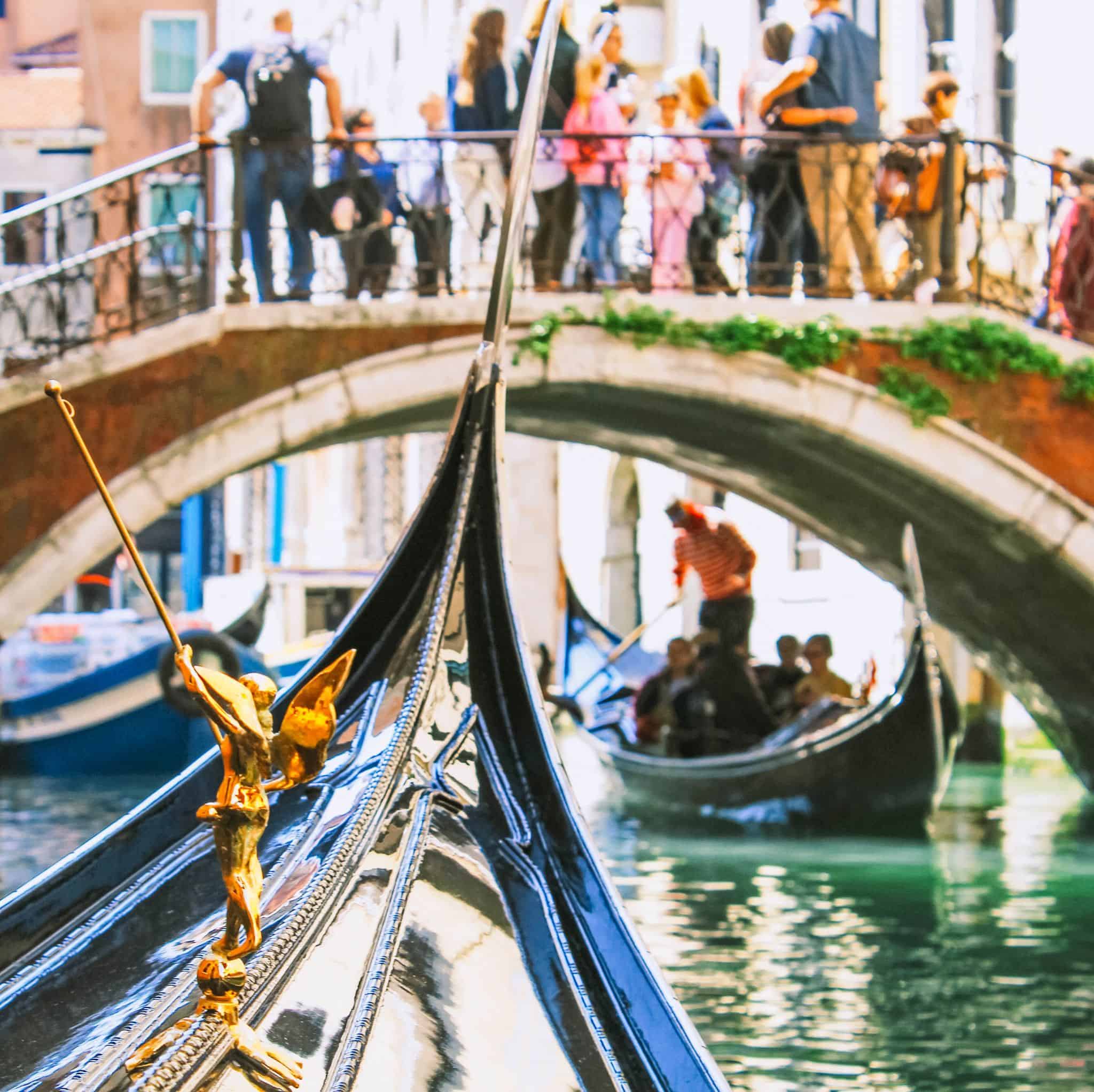
We took a gondola ride through the small canals in Venice on this trip, and it was wonderful to see Venice from the water. I think that’s really the way it should be seen. It seemed uncrowded and fantastical looking at the city from the water.
A 40-minute gondola ride during the day will cost you 80 euros. We could have extended to an hour for another 20 euro, but we had a lot to cram into our day.
Tip for hiring a gondola:
If you want to ride on the Grand Canal in a gondola, hire your driver at San Marco Square or Rialto Bridge. We wanted a quieter ride through the city, so we hired one at one of the smaller bridges in the city.
Get lost and away from the crowds in Venice
This may not be a normal attraction, but I found that this is one of the things we enjoyed most about Venice. We left the area near San Marco and just walked and walked. Everywhere in Venice is very safe, so you can explore to your heart’s content.
We discovered solitary bridges, beautiful gardens, deserted squares, and a little taste of what Venice is truly like. We generally didn’t use a map, we just walked and walked. (We walked 8+ miles that day!)

If you have more time in Venice stop to see:
Murano
You will see tons of Venetian glass in all the shops in Venice. Most of it is made on the island of Murano. You can tour a factory where where glass is made. Most will offer a demonstration of some sort, but beware of pushy salespeople. There is also a nice museum of glass on Murano that goes into the history of Ventian glass. If you can arrange to have one day in Murano you will have tons of time to explore this beautiful area.
Burano
This quiet island is known for having colorful buildings and quiet streets. You won’t find big tourist attractions here, and that is partly what makes it such a great place to spend some time. Enjoy wandering down streets and grabbing a bite to eat.
Day 4 -Florence

Photo Credit: Deposit Photos
Florence is the birthplace of art, music, and literature! It is one of the most magnificent cities in Italy and should be a stop on your road trip in Italy!
Florence hails from the Etruscan culture and was built by Julius Caesar in 59 BC. Today, Florence is one of the most visited cities in the world!
Tourists flock to Florence to see the Uffizi Gallery, The Dumo, Boboli Gardens, and much more!
The Duomo in Florence

Photo Credit: Travels With The Crew
The Duomo is the heart of the city of Florence. Any pictures you see of Florence will invariably feature the terra-cotta roof of the Duomo.
This cathedral is called the Duomo, which means the house of the bishop. However, the entire name of the church is the Basilica of Santa Maria del Fiore. The exterior is made of different colors of marble, and is extensively decorated with friezes, statuary and stained glass windows. It is truly awe-inspiring.
It is a masterpiece of Renaissance Florence although it was begun in the late 1200’s. Its famous dome was built in 1417. Statuary and colored marble was added to the exterior up until the late 1800’s.
Plan on 30 minutes to 1 hour to explore the outside and more to visit the interior or climb the dome.
Tips for visiting the Duomo:
- The interior is not particularly impressive. Save the 5 euros and visit the interior of the duomo in Siena or climb the tower of the Duomo in Florence.
- If you want to climb the dome make sure to book your ticket in advance!
The David

Photo Credit: Travels With The Crew
After the Mona Lisa, The David might be the most famous work of art in the world. Sculpted by Michelangelo in the early 1500s, The David was meant to be a depiction of biblical King David in his youth. This statue stood in the Palazzo Vecchio for centuries and was moved into the Accademia Gallery in 1873 to protect it from damage.
Today you can visit The David at the Accademia Gallery or visit a replica in The David’s original home in the Palazzo Vecchio.
Plan on 1-2 hours to get into the museum and visit.
Tip: If you are traveling with small kids, skip the Accademia gallery and show them the replica. It beats standing in the long entrance line.
Palazzo Vecchio

Photo Credit: Travels With The Crew
Translated into English, Palazzo Vecchio means “old palace.” This was the principal palace in Florence before the building of the Pitti Palace across the Arno River. The original David sat on one side of the entrance to Palazzo Vecchio for hundreds of years.
Today the Palazzo is open for tours, and there are some beautiful works of art in the palace. Most of the sculptures and frescoes were created by some of the greatest artists of the Renaissance.
Plan on 1 hour.
Piazza Della Signoria

Photo Credit: Travels With The Crew
Also called Piazza Vecchio, this square is outside of the Palazzo Vecchio and is the home to the Loggia dei Lanzi which is a covered area with iconic statues such as “Rape of the Sabines” by Giambologna and the statue of Perseus by Cellini. Also on the square is the fountain of Neptune by Bartolomeo Ammannati. Restoration of the fountain was just finished last year.
It is amazing to see so many spectacular works of art just out in a public square! My kids especially like the statue of Perseus as they are big Percy Jackson fans.
This square was the site of ancient Florence’s trade and a gathering place for politicians.
Plan on an hour to explore.
Ponte Vecchio

Photo Credit: Travels With The Crew
Just down from the Palazzo Vecchio and Piazza Della Signoria is another famous Florentine landmark. Ponte Vecchio is a historic bridge of the Arno River. For centuries it was the only bridge across the Arno. Shops line both sides of the bridge as they did in the 13th century.
Immortalized in the Puccini aria, “O Mio Babbino Caro” and countless books and movies you will definitely recognize this bridge.
Plan on 30 minutes to walk it and take pictures.
Uffizi Gallery

Photo Credit: Depositphotos
The Uffizi Gallery is one of the world’s best known museums. It houses Leonardo Da Vinci’s “Adoration of the Magi”, Raphael’s “Madonna of the Goldfinch”, and Botticelli’s “The Birth of Venus” among hundreds of other famous works of art. While it is fascinating for art lovers and history lovers, it may not be your kids’ favorite destination.
So if you plan on being in Florence for a few days, book the Best of Florence for 3 days and you can do 30 minutes a day in the Uffizi and still see the highlights. Plus the 3 day pass gives you access to Pitti Palace and Boboli Gardens. Check our what the Uffizi has to offer with this guide.
Plan on 1-2 hours
Boboli Gardens and Pitti Palace

Photo Credit: Travels With The Crew
The newer palace across the Arno River is Pitti Palace. Pitti Palace is now a museum that contains paintings from the 16th century, treasures of the Medici family, costume gallery and the Porcelain museum. The Boboli gardens were the extensive gardens of the Pitti Palace. The gardens are Italian in style and feature statuary, fountains, and grottos. The gardens are a wonderful place to explore on sunny day.
Plan on 1-3 hours.
Day 5-7 – Tuscany

Photo Credit: Deposit Photos
I’m not sure there is a Tuscan town that isn’t worth visiting, but I have been to Tuscany before and wanted to see my favorites, plus a few new ones. We enjoyed every one of them and wish we had another week to visit more. If you are wondering what else there is to do in Toscana (the Italian word for Tuscany), all you have to do is go for a drive, and you will find something charming and worthwhile.
Below are the cities and towns we visited during our days in Tuscany. We stayed in the charming town of Certaldo Alto and did day trips from there. It was great to have a few nights in one place!
Siena

Photo Credit: Travels With The Crew
Siena, arguably the second most well-known city in Tuscany, was settled around the same time as Florence and, at one point, was Florence’s biggest rival. It’s a much smaller and more walkable town than Florence but with all (if not more) Tuscan charm.
Here are all of the best things to do in Siena.
The Duomo in Siena

Photo Credit: Travels With The Crew
The Duomo in Siena was built to rival the Duomo in Florence, and you will be amazed at their similarity in design, although the one in Florence is much bigger. Siena’s Duomo is as beautiful on the inside as on the outside and is well worth the ticketed entry.
White and green marble and carvings are as intricate in the interior as the exterior. The floors are decorated with large mosaics telling stories beloved by the Tuscans. I can’t recommend this enough!
Plan on 30 minutes to an hour.
Piazza Del Campo

Photo Credit: Deposit Photos
This town square is the most well-known in Siena. It is a very different piazza in that it is shell-shaped and slopes down to the center of the square. It is a great place to get a bite to eat or relax in the sunshine, surrounded by ancient buildings and churches.
Plan on a walk-through only.
Palazzo Publico

Photo Credit: Travels With The Crew
This palace was the seat of power for Siena during the 1300s. It is set on the Piazza Del Campo. Frescos decorate almost every wall, and the palace is a well-preserved example of Gothic Architecture. The best-known fresco is the allegory of Good vs Bad Government.
Plan on 1 hour.
Basilica Cateriniana San Domenico

Photo Credit: Travels With The Crew
This is a lovely church to visit and is one of the few churches dedicated to a woman, Catherine of Siena. It supposedly contains the head of St. Catherine (a little gruesome but still interesting). The basilica also offers spectacular views of Siena. (The picture at the top of the Siena section was taken from the Basilica.)
Plan on 30 minutes.
Osteria Permalico

Photo Credit: Travels With The Crew
This was one of our very best meals in Italy! It was also one of the least expensive. I loved the ricotta gnocchi with a light pistachio cream sauce, while my husband loved the peposo (peppered beef stew). The boys were happy with pomodoro pasta. They have outdoor as well as indoor seating.
San Gimignano

Photo Credit: Travels With The Crew
San Gimignano is pronounced San jeem-een-YAH-no. The first time I visited the town, I struggled with the pronunciation, but after much practice, I seem to have mastered it. San Gimignano is a beautiful town to visit and I can tell you why you want to visit this off-the-beaten-path town.
GELATO! The gelato world champion owns a shop in San Gimignano. The Gelataria Dondoli has dozens of flavors and plenty of different sizes for every appetite. My favorite was Amerena, but the lemon and hazelnut were standouts as well. The line is long, but it moves very quickly.
If gelato doesn’t excite you, you could also visit the towers of San Gimignano. Fourteen of the seventy-two original towers remain in the ancient city. The towers were symbols of wealth and power, and the wealthiest families built taller and taller towers.
Be sure to climb Torre Grossa (the tallest tower) for a beautiful look at San Gimignano and the Tuscan countryside.
Certaldo Alto

Photo Credit: Travels With The Crew
We came upon this lovely hilltop town by fortunate happenstance. We booked the only Airbnb in the entire walled city. The town is on top of a hill overlooking Certaldo below and is completely walled in. No cars are allowed without a resident pass, and even those are parked away from view.
This is a small town kept from expansion by the confines of the hilltop. It dates back to the Etruscans and has been revitalized with each successive conquerer. It makes exploring this city of red brick an adventure. Everything seems to be built on top of the next, with small alleyways and roads in haphazard locations.
The best thing about Certaldo Alto is that it isn’t in any guidebook we read, so we had the place to ourselves for much of our stay in Tuscany!
Tip:
- If you aren’t fortunate enough to stay in Certaldo Alto, you can ride to the top in the funicular from the train station in Certaldo or walk up the steep hill along several different paths or the road.
Lucca

Photo Credit: Travels With The Crew
Lucca was one of our very favorite towns in Tuscany. It is one of Italy’s best examples of a walled city, and the walls are very well preserved. It was the 2nd largest city-state in Italy (Venice was the 1st) and was eventually conquered by Napoleon. He gave it to his sister, who took it on as a pet project, and it is, therefore, one of the better-preserved cities in the area.
The Walls of Lucca

Photo Credit: Travels With The Crew
Our favorite part was the walk through the outer walls into the city. Passageways through the walls are cobblestoned with interesting sculptures and some great lighting! Park outside the city walls so you can walk through these otherworldly walls.
Once you get out of the wall, you will walk up to the top of the walls and join other people walking, riding bikes, and riding group bikes. Rentals are available at several different locations along the promenade atop the walls. You can rent single bikes, tandem bikes or bikes for big groups.
Lucca’s Guinigi Tower

Photo Credit: Travels With The Crew
Another great stop in Lucca is Guinigi Tower! Walk up 232 steps to the top of the tower and get a great view of the entire city. The top of the tower has trees on top, which makes it an unusual change from most towers in Italy.
Pisa

Photo Credit: Travels With The Crew
The Leaning Tower of Pisa needs no introduction! The tower began leaning while it was being built and has leaned ever since. Uneven and inadequate foundation led to the leaning, and today it is 5 meters off of a straight line. It was built as a tower for the Cathedral of Pisa.
Pisa is a busy place. If you want to visit at certain time, so you will want to get a skip-the-line ticket to climb the tower at least a week in advance (especially if you have time constraints). You can visit the tower area without a ticket, and your kids will have a blast taking pictures of the tower of Pisa.
Plan on 1 hour.
Day 8 and 9 -Cinque Terre

Photo Credit: Travels With The Crew
We only had one day to spend in Cinque Terre and wanted to see as much as possible. We started super early and got to see tons of beautiful coastlines as well as some very charming towns.
Cinque Terra means “five lands” in Italian and refers to five small fishing villages built on the side of the steep mountains in northwestern Italy. The villages starting from the most northern and going south are: Monterosso al Mare, Vernazza, Corniglia, Manarola, and Riomaggiore.
These towns remained isolated (the Ligurian Sea on one side and the Apennines mountains on the other) until about 150 years ago when the railroad went in and connected them with the outside world. Visiting this area offers a glimpse into the unique Ligurian culture, geography, terraced vineyards, and art. This entire area is a national park and is protected by UNESCO as a world heritage site.
Check out this post to find out how to do Cinque Terre in one day.
Day 10 -Pompeii

Photo Credit: Travels With The Crew
Pompeii has captured the imagination of architects and laypeople alike for over 100 years. A town completely entombed in mud and ash and then discovered again 1000 years later!
Mt. Vesuvius is a volcano that erupted in AD 79instantly killing the inhabitants of Pompeii. They were killed because of the heat and not because of the ash like it was previously postulated. No wonder people flock to one of the oldest cities still on earth.
This place is massive! You could spend the day rambling down ancient road after ancient road and still just scratch the surface. And there is even more remaining to be uncovered.
My favorite ruins are ones that have retained the paint treatments, sculpture, and tile. Some have come through the volcanic eruption better than a Roman ruin 500 years younger!
Plan on 3-5 hours.
How to Skip the Line at Pompeii

Photo Credit: Travels With The Crew
Now the bad news . . . This is one popular place! This is a picture of the line to get in on weekday in April.
Buy the skip the line tickets at least a week before so they won’t be sold out.
We had skip-the-line tickets on our phone, but even that line was 2 hours long! My recommendation is to get the skip-the-line ticket and get there as early as possible!
Tips for visiting Pompeii

Photo Credit: Travels with the Crew
- Plan on wearing some layers. It was quite cool on an April morning, but by mid-day we were all sweating.
- Wear some closed toe shoes; there are many uneven rocks and old paving stones that will catch little toes.
- Your shoes will be dusty, don’t wear your pretty pink shoes! (Mine are now a very dusty, dirty grey!)
- There are different entrances to Pompeii, but only the main one offers the skip-the-line option. Try a different entrance if both the skip-the-line and the regular line are eternally long.
- There is a place to leave your luggage in Pompeii if necessary.
- There are not many eating options in Pompeii! Plan on bringing a snack.
- Bring water!
- Use the bathroom at the entrance, as there aren’t good choices once you enter.
- Don’t bring your stroller if you have other options. The roads are rutted, and the sidewalks aren’t always passable. It would be much better to bring a baby carrier or backpack.
- Pompeii is very near the beautiful Amalfi Coast; plan a visit if you have time. Positano was on my list!
Do you only have 1 week to spare it Italy

Photo credit: travels with the crew
This itinerary is very easily adaptable for just one week in Italy. If you only have one week to spend in Italy, you will either have to skip Venice and Pisa or Pompeii.
You just need to decide what is most important to you and your family.
The Best Time of Year to Visit Italy

Photo Credit: Travels With The Crew
Spring and fall are generally considered the best times of year to visit Italy. The crowds are less, the weather is beautiful, and some entry prices are lower. We loved the weather in April and would recommend it highly. It was a beautiful time to see Italy as there were flowers blooming and trees budding.
If you plan on summer in Italy, you will still have a great time! Just plan on more time to do things and dress for warm weather!
If you want to visit in the winter you can take advantage of the low prices of hotels and enjoy Italy without the crowds.
10 Days in Italy Travel Tips

Photo Credit: Travels With The Crew
- Brush up on your Roman and Greek gods. We were so glad we had a working knowledge of Roman and Greek gods. It made the art and statuary understandable to all of us and helped us appreciate it more.
- Research the famous artwork before visiting. Your kids will be much more willing to do another museum if they are familiar with and excited about the artwork they visit.
- Get your skip-the-line tickets at least a week in advance in the low season or many weeks in advance during the high season.
- Decide what you want to buy for souvenirs ahead of time with my excellent post on Italian souvenirs.
Get five more great tips for your trip to Italy for free when you subscribe to our blog!
Check out my other Italy content here:
Things to do before your trip to Italy
There may be affiliate links in this post. Read my disclosure policy to learn more.


The next time you and The Crew visit Italy, come to Milan! Milan is a beautiful city which is modern compared to Southern Italy and Toscana.